SIMPLE - Wikipedia, the free encyclopedia
Found this out tonight, when I upgraded to adium-1.5.8b1.
Added my SIP account to adium, but I don't know of anybody using "SIP / SIMPLE". Is anybody out there, who can contact me à la "SIP / SIMPLE"?
Sunday, September 8, 2013


Wednesday, September 4, 2013
resetting the DNS cache: OS X, Firefox
- OS X: How to reset the DNS cache
- Windows (Vista): http://en.kioskea.net/faq/10548-vista-reset-the-dns-cache
- https://addons.mozilla.org/en-US/firefox/addon/dns-cache/ – has usability issues according to the reviews
- http://www.techiecorner.com/225/how-to-disable-firefox-dns-cache/ – go for the manual approach:
- Introduce 2 new variables within about:config:
- network.dnsCacheExpiration (integer / 0)
- and network.dnsCacheEntries (integer / 0);
- my problem with this: if you want to reset these switches, that's fine with Firefox, just that they get their data types changed to "string"; and once, you want to set them again to "integer / 0", you simply can't; for the time being I just assume, Firefox doesn't seriously consider the data type and accepts "string" for these 2 as well.
rsync with --fuzzy
- BackupAssist Support Forum • View topic - Rsync with --fuzzy
- http://www.snowfrog.net/2011/03/03/fuzzy-rsync/
- http://samba.2283325.n4.nabble.com/fuzzy-search-over-to-be-deleted-files-to-catch-moved-files-and-directories-td2511769.html – in this thread "henrik" AKA H. Langos-8 describes in a rather detailed way exactly what I was thinking of: renaming and moving files within the directory structure (actually my idea isn't restricted to "within …") w/o changing them (actually rsync-ing such files) should be made rather cheap; but that discussion dates back to 2009 …
My impression is, that --fuzzy writes the destination file again, making use of chunks from the old, neighbour destination file. That's certainly cheaper than sending files over the wire, but still … .
Root Checker - Android Apps on Google Play
Root Checker - Android Apps on Google Play
Once you are rooted, you want to be sure, you really are.
Once you are rooted, you want to be sure, you really are.
Scott Berkun: why it’s ok to buy books and not read them
Why it’s ok to buy books and not read them
"I used to feel guilty about books I own but haven’t read. They’d sit in piles making me feel unworthy as a writer, and reader. And no matter how many books I’d read in a year, I’d always find myself buying more. I couldn’t win. It was a destructive cycle and it drove me mad. …"
Tuesday, September 3, 2013
how to keep folders in sync over the Internet ("long-distance", not LAN)? I mean *sparingly*
So far I have been using rsync for this purpose, but there is still space for optimizations.
If I locally rename a big file, next time my "rsync -vaz --delete-after" will copy the file using the new name and remove it using its old name. I would actually prefer to see the file getting renamed remotely.
Posted this issue on the rsync user mailing list [link].
In response to that, I received a message pointing me to the "should" tool [link].
Posted this issue on the rsync user mailing list [link].
In response to that, I received a message pointing me to the "should" tool [link].
the "vi" built into busybox-1.16.1 on my Synology DiskStation DS213+ just fooled me
I was trying to find an occurrence of /lib/cpp in a log file, and I wanted to avoid using '/' in a regexp, so I tried 'lib.' instead. But that didn't match the obvious occurrence. I executed a ":set magic"; the command got accepted, but that still didn't change its behaviour. Installed VIM, tried the same, and everything worked as expected. Still a little frustrating. It looked like I am loosing even my basic VI competence.
Expecting Sven G.'s "like it" on FB…
Expecting Sven G.'s "like it" on FB…
(cross) development toolchain for the Synology DiskStations (DS213+, DS112+, …) – which CPUs do they use?
The gcc supplied by ipkg (for this model) is an ancient 3.4.6, apparently so outdated, that you cannot configure and compile "current" sources, at least neither a current rsync nor a current gcc.
I guess I should go for Synology's own toolchain for the DS213+. Where do they supply that? At www.synology.com > Support > Developers > "Request GPL Source" they point you to sourceforge.net/projects/dsgpl/. Looks like EnvDeploy inside that tarball is the starting point.
To be continued …
I guess I should go for Synology's own toolchain for the DS213+. Where do they supply that? At www.synology.com > Support > Developers > "Request GPL Source" they point you to sourceforge.net/projects/dsgpl/. Looks like EnvDeploy inside that tarball is the starting point.
According to the "Synology NAS Server 3rd-Party Apps Integration Guide.pdf"
- the DS213+ has a "Freescale QorIQ P1022"; /proc/cpuinfo calls the CPU an e500v2, that's a kind of PowerPC; the toolchain set-up scripts calls it "qoriq";
- and the DS112+ has a "Marvell 6281" or a "Marvell 6282"; /proc/cpuinfo calls the CPU a "Feroceon 88FR131 rev 1 (v5l)", that's an ARM processor; the toolchain set-up script calls it "6281";
To be continued …
Monday, September 2, 2013
modding Synology DiskStations: Ernst Martin Witte on optware/ipkg
Ernst Martin Witte's Homepage - Optware/ipkg (hopefully) right on Synology DS213+ with DSM 4.2
Maybe it has valuable hints for more difficult compilation issues.
Maybe it has valuable hints for more difficult compilation issues.
the IPKG optware development toolchain for Synology DiskStations
http://forum.synology.com/wiki/index.php/Overview_on_modifying_the_Synology_Server,_bootstrap,_ipkg_etc
Recently I found IPKG actually got abandoned, and the IPKG Perl on one of my Synology DiskStations wasn't really functional at all (some broken dependency on a library to be loaded dynamically).
That really frustrated me for a short period. Now I installed the IPKG optware-devel (compilation toolchain) and esp. gcc. Downloaded rsync sources, proceeded "as usually" with GNU sources, and it simply works. That's phantastic. I have really been worried for quite a while with that restricted Synology provided rsync, and the IPKG rsync didn't really comfort me there, so having "my own" rsync is really a nice thing. Next thing will be compiling my own Perl; and I will even be able to install CPAN modules with C sources, as I even have a C compiler.
Actually I should consider bootstrapping gcc, the GNU C compiler, because gcc-4.2.3 is a little outdated. gcc for my other DiskStation is even older, it's a gcc-3.x. But than those gcc-s create code, that runs on these DiskStations, and not really bad.
Looks like my Synology DiskStations even work well as development systems.
Recently I found IPKG actually got abandoned, and the IPKG Perl on one of my Synology DiskStations wasn't really functional at all (some broken dependency on a library to be loaded dynamically).
That really frustrated me for a short period. Now I installed the IPKG optware-devel (compilation toolchain) and esp. gcc. Downloaded rsync sources, proceeded "as usually" with GNU sources, and it simply works. That's phantastic. I have really been worried for quite a while with that restricted Synology provided rsync, and the IPKG rsync didn't really comfort me there, so having "my own" rsync is really a nice thing. Next thing will be compiling my own Perl; and I will even be able to install CPAN modules with C sources, as I even have a C compiler.
Actually I should consider bootstrapping gcc, the GNU C compiler, because gcc-4.2.3 is a little outdated. gcc for my other DiskStation is even older, it's a gcc-3.x. But than those gcc-s create code, that runs on these DiskStations, and not really bad.
Looks like my Synology DiskStations even work well as development systems.
how to put Mac OS X Lion in Hibernate (Deep Sleep) mode – and how to disable it again
$ sudo pmset -a hibernatemode 25
$ sudo pmset -a hibernatemode 3
$ sudo pmset -a hibernatemode 0
finally fixed this problem with Google Maps on my Android smartphone: "please enable google apps location access"
[Android] What is "Please enable Google apps location access" error in Google Maps and how to fix it [dotTech Explains] | Reviews, news, tips, and tricks | dotTech
My Android smartphone wouldn't let me simply enable determining my location via GPS within Google Maps. It complained: "please enable google apps location access". The above article pointed me "here": System settings > Accounts > Google > Privacy > Locations settings > "Let Google apps access your location".
I think, with my smartphone "out there" I had run into this problem quite a few times during the last couple of months, never really properly investigating it at my desk. The investigation didn't really cost me a lot of time, but … you know … – now at least the issue is solved.
My Android smartphone wouldn't let me simply enable determining my location via GPS within Google Maps. It complained: "please enable google apps location access". The above article pointed me "here": System settings > Accounts > Google > Privacy > Locations settings > "Let Google apps access your location".
I think, with my smartphone "out there" I had run into this problem quite a few times during the last couple of months, never really properly investigating it at my desk. The investigation didn't really cost me a lot of time, but … you know … – now at least the issue is solved.
Saturday, August 31, 2013
Thursday, August 29, 2013
my new "mobile NAS": Synology DS112+
DS112+ Products - Synology Inc. Network Attached Storage
Installation procedure from CD-ROM:
- you are starting with a DiskStation with a bare disk, i.e. no DSM (the DS Management system)
- mount the supplied CD-ROM
- mount DSAssistant-SYNOLOGY_….dmg from the CD-ROM
- run the assistant App from there
- the assistant App helps you installing the DSM, either from a DSM_DS112+_….pat file (around 40 MB large) on the CD-ROM (it comes with DSM-4.1) or from a file you download from the Synology website (bleeding edge: DSM-4.3)
- that includes formatting the hard disk
Installation procedure following following the quick set up leaflet:
- surf to find.synology.com
- it is meant to discover all reachable Synology DiskStations
- in this situation it does not find the DiskStation in question (running a DSM)
- it points you to DSAssistant-SYNOLOGY_….dmg, to be downloaded from the Synology website
- mount the downloaded DSAssistant-SYNOLOGY_….dmg
- run the assistant App from there
- …
Because I had temporary trouble accessing the supplied CD-ROM, I had to download the DSAssistant…, but I used the DSM-4.1 on the CD-ROM. That decision was unreasonable and done a little too fast, as I seriously intended to operate using DSM-4.3. So in the meantime I downloaded DSM-4.3, and after having set up DSM-4.1 entirely and properly, I set up DSM-4.3.
Further steps:
- setting up a personal user account
- allowing SSH access
- SSH log-in in using the root account
- modifying /etc/passwd to allow shell login for the user accounts in question (the resp. record has a "nologin" instead of a proper shell path)
Further steps:
- I followed the instructions listed in my own "my new NAS (…): Synology DS213+" (taken from somewhere else and my own experience)
- install the ipkg installation system
- install a proper rsync through ipkg; I will have to call this rsync as /opt/bin/rsync from now on
- "standard standard" installation is broken for the DS112+, but the wiki page describes the actual standard procedure including a fix in some bootstrap.sh
- commenting out the standard PATH setting in ~root/.profile and ~MY_ACCOUNT/.profile
- my first personal rsync-s to the DiskStation
Friday, August 23, 2013
O'Reilly Media book: Learning R
Learning R: 
If you do any kind of data analysis, you need R in your toolkit. This book teaches you how to be productive with this important programming language for statistics by covering everything about R you need to know, including data gathering, transformation, visualization, modelling, and publishing.
If you do any kind of data analysis, you need R in your toolkit. This book teaches you how to be productive with this important programming language for statistics by covering everything about R you need to know, including data gathering, transformation, visualization, modelling, and publishing.
Rocky Nook book: Testing Cloud Services
http://shop.oreilly.com/product/9781937538385.do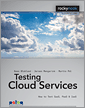
Everybody is confronted with cloud computing. Whether you are a user, designer, programmer, project manager, or tester, sooner or later the cloud affects your work. If you are involved in selecting or implementing services from the cloud, or in keeping them up and running, this book will prove to be an invaluable resource.
Testing Cloud Services covers an extensive list of risks that arise when implementing cloud computing, including some traditional risks and some completely new ones, and provides strategies for avoiding these risks and solving problems. Every risk is connected to existing, updated, and new test measures. It is necessary to start testing during the selection of cloud services, and continue end-to-end testing even after going live, as continuity risks arise all the time.
Everybody is confronted with cloud computing. Whether you are a user, designer, programmer, project manager, or tester, sooner or later the cloud affects your work. If you are involved in selecting or implementing services from the cloud, or in keeping them up and running, this book will prove to be an invaluable resource.
Testing Cloud Services covers an extensive list of risks that arise when implementing cloud computing, including some traditional risks and some completely new ones, and provides strategies for avoiding these risks and solving problems. Every risk is connected to existing, updated, and new test measures. It is necessary to start testing during the selection of cloud services, and continue end-to-end testing even after going live, as continuity risks arise all the time.
O'Reilly Media book: Git Pocket Guide
Git Pocket Guide: 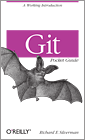
This pocket guide is the perfect on-the-job companion to Git, the distributed version control system. It provides a compact, readable introduction to Git for new users, as well as a reference to common commands and procedures for those of you with Git experience.
This pocket guide is the perfect on-the-job companion to Git, the distributed version control system. It provides a compact, readable introduction to Git for new users, as well as a reference to common commands and procedures for those of you with Git experience.
SitePoint book: Jump Start Rails
Jump Start Rails: 
Jump Start Rails provides you with a fun and yet practical introduction to Rails, an incredibly popular framework that makes it possible to quickly develop incredibly powerful web applications with Ruby. This short book covers Rails 4, the latest version of the framework, and while it's not intended to be a completely comprehensive Rails guide or an in-depth Ruby tutorial, it will quickly get you up to speed with Rails and give you the confidence to start experimenting on your own.
The book is built around a real-life example project: a personal portfolio site. It's a fun and easily understandable project that is used to demonstrate the concepts outlined in the book in a practical way.
This is a clear, approachable and very easy-to-follow book that will get you to to speed with Rails in no time.
Jump Start Rails provides you with a fun and yet practical introduction to Rails, an incredibly popular framework that makes it possible to quickly develop incredibly powerful web applications with Ruby. This short book covers Rails 4, the latest version of the framework, and while it's not intended to be a completely comprehensive Rails guide or an in-depth Ruby tutorial, it will quickly get you up to speed with Rails and give you the confidence to start experimenting on your own.
The book is built around a real-life example project: a personal portfolio site. It's a fun and easily understandable project that is used to demonstrate the concepts outlined in the book in a practical way.
This is a clear, approachable and very easy-to-follow book that will get you to to speed with Rails in no time.
O'Reilly Media book: Mastering Perl, 2nd edition
- http://shop.oreilly.com/product/0636920012702.do
- http://chimera.labs.oreilly.com/books/1234000001527 – on "Atlas"
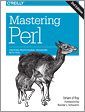
Supercharge your Perl knowledge with advanced concepts to make coding easier, maintenance simpler, and execution faster. It’s possible with this thoroughly updated edition of Mastering Perl, the third in O’Reilly’s series of landmark Perl tutorials.
O'Reilly Media book: Oracle Essentials, 5th edition
Oracle Essentials: 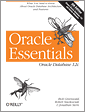
Written by experienced Oracle insiders, this easy-to-read volume covers every aspect of the Oracle database for readers of all technical levels. The book includes information on Oracle's product line, architecture, data structures, networking, concurrency, tuning and more.
Written by experienced Oracle insiders, this easy-to-read volume covers every aspect of the Oracle database for readers of all technical levels. The book includes information on Oracle's product line, architecture, data structures, networking, concurrency, tuning and more.
brian d foy's book "Mastering Perl": New to “Modules as Programs” (AKA Modulinos)
In the end you will find a [link] to the entire new respective chapter.
New to “Modules as Programs”:
I (that refers to brian foy) keep wanting to name this chapter “Modulinos”, but that doesn’t mean much to someone who doesn’t have that idea yet, so I leave it as is.
For awhile, I’ve wanted to reduce the modulino idea to a single statement, perhaps a
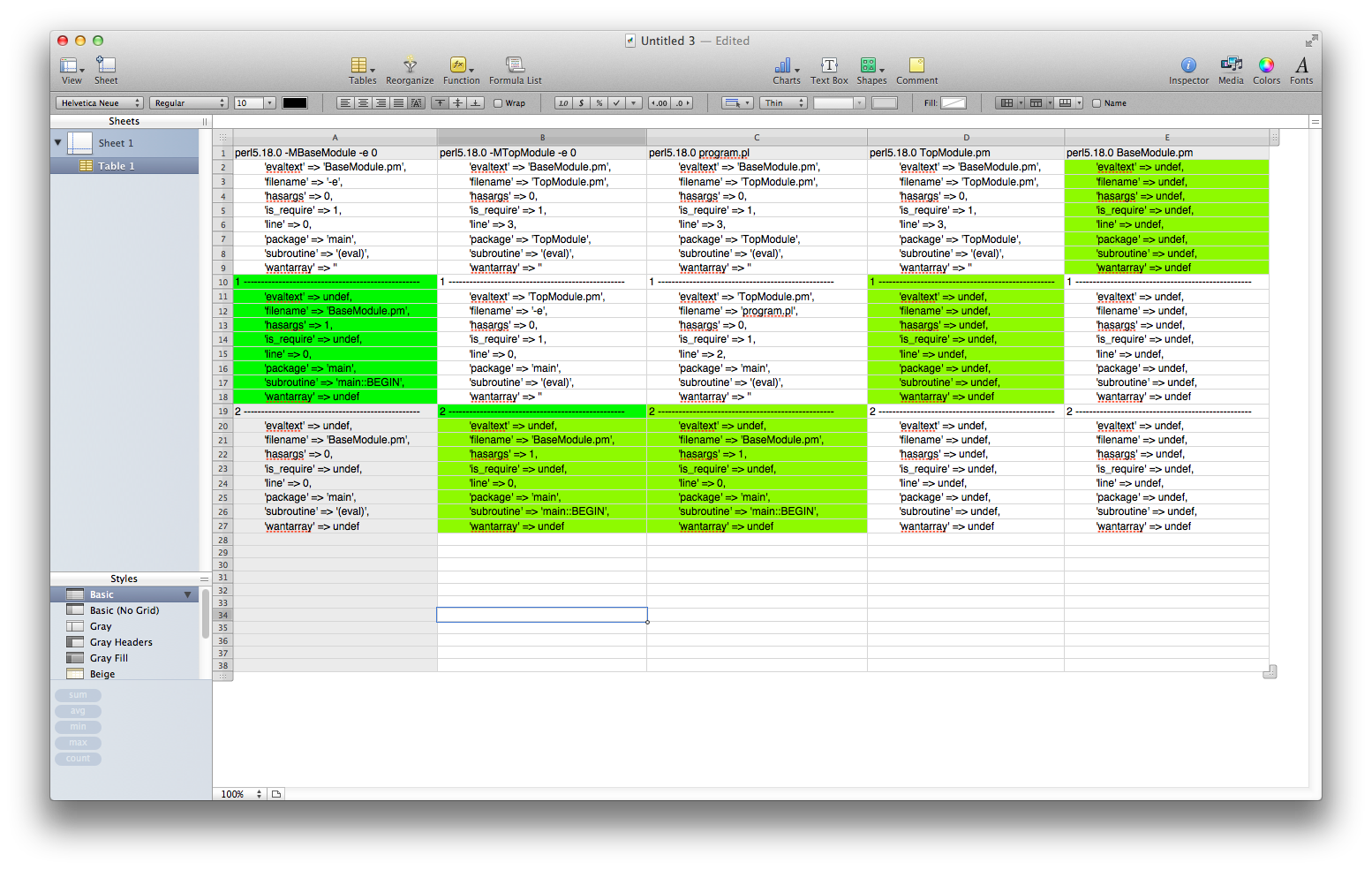 The danger with any code written specifically for a book is that it hasn’t been used widely and its problems haven’t appeared. I know they are there. Not only that, once the book is done, the author tends to stop supporting the code. I certainly plan that because I think the idea is simple enough that no one should use a module for it. That is, no one should create an external dependency to get something so simple.
I’ve also expanded the modulino idea. Previously, it was about running as a program or loading as a module. However, we can do other things based on any condition. The module can run as a test script. Modulino::Base looks for methods that start with
Beyond that, I experimented with having a module file be a template for its own documentation. Using some switch to say I wanted to read the docs, it ran Pod::Perldoc on itself, making modifications to the Pod along the way, such as automatically inserting the right package name. I like that idea and I think there’s more behind it, but it’s not something I want to delay the book for.
You can check out this chapter in O’Reilly Atlas.
New to “Modules as Programs”:
I (that refers to brian foy) keep wanting to name this chapter “Modulinos”, but that doesn’t mean much to someone who doesn’t have that idea yet, so I leave it as is.
For awhile, I’ve wanted to reduce the modulino idea to a single statement, perhaps a
use statement:use Modulino;I think I’ve got most of the way there with Modulino::Base, which I’ve included in my update to the chapter. It was an interesting journey though. I didn’t want to inherit from it because it’s not really that sort of relationship. I could add it as a role or trait, but I didn’t want to deal with complication surrounding that. I settled on a
require because the code needs to run after the compile phase when all of the methods are already compiled. That was true of the code that was already controlling that behavior:__PACKAGE__->run(@ARGV) unless caller;Moving all of the code into another file (and using subroutines) messed with
caller a bit. Now I had to look back a couple of levels to see what was going on. That seems simple now that I’ve figured it out, but on the way I loaded Modulino::Base in many ways and looked at caller going two levels back to convince myself I was doing the right thing. As with most coding problems, the other weird things I was trying to do had clouded the problems and simplifying the module solved it.I’ve also expanded the modulino idea. Previously, it was about running as a program or loading as a module. However, we can do other things based on any condition. The module can run as a test script. Modulino::Base looks for methods that start with
_test_ and runs them as subtests if CPANTEST is set to a true value. I stole that idea from Python, although it doesn’t seem to be as popular as it was when I learned that language. Beyond that, I experimented with having a module file be a template for its own documentation. Using some switch to say I wanted to read the docs, it ran Pod::Perldoc on itself, making modifications to the Pod along the way, such as automatically inserting the right package name. I like that idea and I think there’s more behind it, but it’s not something I want to delay the book for.
You can check out this chapter in O’Reilly Atlas.
Wednesday, August 21, 2013
reading a growing file in perl
- How do I read a file which is constantly updating? (Stack Overflow) [link]
- How can I read from continuously updated file in Perl? (Stack Overflow) [link]
Approaches:
- File::Tail (or one of its sisters) is your friend (preferred!)
- use this (together with sleep(...)) for getting EOF reset: seek(LOG, 0, 1) (if you must stay with vanilla perl)
Wrote my 1st script making use of File::Tail today, a "main log file" referring to short other log files. Now I read all of them using File::Tail. Looks good and rather versatile.
Tuesday, July 30, 2013
Threema: yet another instant messaging application for smartphones
Threema - Wikipedia, the free encyclopedia
Desktop versions of Threema (e.g. for Windows or Mac OS X) are on the long-term plan.Looks like security is a main goal, unknown protocol used – that's definitely not a plus.
Subscribe to:
Posts (Atom)


